Workato is taking a giant step in the operationalization of enterprise AI. It is deploying a series of production-ready Model Context Protocol (MCP) servers which allow AI agents to transfer directly out of endless pilots into real business systems at scale. Rather than every company or SaaS vendor developing its own connectors, Workato thinks that a standardized and hardened MCP layer will be the missing infrastructure of the agentic enterprise age.
Between smart demos and actual work.
In the past two years, the majority of large organizations have tried AI agents capable of chatting, summarizing, and responding to questions. The next step has been the real bottleneck, which is providing those agents with controlled and auditable access to calendars, CRMs, code repos, identity systems, and collaboration tools to actually do things. In 2024, MCP became the common protocol of exposing the tools and data to AI models in the ecosystem by Anthropic. However, a protocol, in itself, is not the solution to the painful aspects that the enterprises are concerned with: security models, uptime guarantees, role-based access, audit logs, compliance, and continued maintenance. That is the gap that Workato is aiming at. The company is basically transforming its battle-tested integration and automation stack into a managed MCP infrastructure that can be accessed by any AI agent.
What Workato is launching
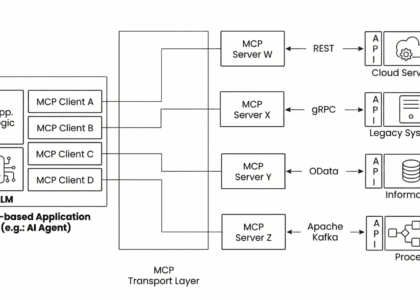
The new product is a pool of hosted, production-grade MCP servers in between AI agents and enterprise systems. Workato is launching eight pre-built servers in communication, collaboration, and IT operations, and has a roadmap to launch over 100 servers by the end of the year.
The first wave covers:
Google Calendar – checking the availability, arranging meetings, and handling events.
Google Sheets – reading and updating the data in spreadsheets, adding rows, and other structured data manipulation.
Google Directory – finding people and organization information within the company.
GitHub – browsing repositories, issues, pull requests and code history.
Gong – drawing of call recordings, transcripts and meeting context.
Slack – browsing discussions and channels, leaving messages and being a member of threads.
Jira – creating, locating, and updating issues without interfering with current workflows and permissions.
Okta – identity searches, group searches, and other identity functions.
Workato hosts all of these, and includes security, access control, and compliance built-in, so that enterprises do not need to set up infrastructure, manage keys, or develop custom wrappers; instead, they simply configure what agents can access what MCP servers and with what permissions. Workato now runs multi-step AI workflows with the same orchestration engine it uses to execute traditional iPaaS flows under the hood. A customer context may be dragged across apps by an agent, have a follow-up scheduled, write a message in Slack, and record the interaction in a system of record, and it may not be glued with custom glue code per step.
In the case of most enterprises, the model is not the hardest aspect of AI, but everything surrounding it. Workato is specifically addressing three pain points that have slackened serious deployment:
Vendor-specific, disjointed strategies.
SaaS vendors are also beginning to open MCP endpoints or model-specific tooling, but each of them has its security model, idiosyncrasy and constraints. That results in an untidy patchwork that is difficult to rule centrally.
Scalability Security and governance.
Granular roles, audit logs, separation of duties, and predictable uptime are required in large organizations. It is costly and risky to replicate all of that with each AI integration. It is much easier to certify and monitor a shared MCP infrastructure that has consistent controls.
The cost of custom servers
In the absence of such, teams either postpone their AI plans or take months to develop and maintain their own MCP servers per system. The idea behind Workato is straightforward: take what is already running at scale with thousands of customers and not recreate the stack. Workato is attempting to become the enterprise MCP backbone by attempting to do to AI agents what iPaaS did to APIs and SaaS integrations a decade ago: transform custom one-off projects into a managed platform capability.
Integrating with the larger Workato ecosystem.
These MCP servers are not coming out of the blue. They are based on Workato Enterprise MCP, which was announced previously, which links enterprise systems to AI agents like Claude, ChatGPT, and developer tools like Cursor in a controlled manner. The new servers ensure that such agents do not communicate with Workato on a high level only (run this recipe). Instead, they may simply invoke fine-grained tools that are made available by MCP, such as list issues, check group membership, pull a call transcript, and Workato implements policies in the background. For AI teams, that means:
An accelerated prototype to production processes.
Reverse engineering of existing Workato recipes and automations into callable tools.
One location to control the agents that can access what systems and actions.
What customers and IT leaders want.
The quotes of IT leaders at the time of the launch create a consistent picture: the primary obstacle to agentic AI is the level of engineering required to safely interface agents with real systems. MCP provides a standardized interface to APIs and services to AI, instead of custom middleware. Workato has a role in that by encasing that in an enterprise-grade infrastructure, enabling AI to have a controlled understanding of what data is available and what can be done within the current corporate boundaries. That flexibility and guardrails combination is precisely what CIOs and IT operations leaders have been seeking: to be able to experiment fast without having to leave uncontrolled backdoors into the important systems.
Roadmap: much further than the initial eight servers.
The ambition of the company is not secret. In addition to the first eight servers, Workato will deliver over 100 MCP servers throughout the year, with the direction of customer demand through an open roadmap. Since Workato already has an integrations portfolio, it can be expected that most of the current AI assistant concepts will be brought to life as cross-system workflows, covering the key CRM, ERP, HRIS, and data platforms. Assuming that Workato delivers on that roadmap, AI teams would be able to move their responses to “We’ll need three quarters to get these systems to work with our agents” to Let’s turn on the MCP servers we need and work on the experience and policies.
To existing businesses that are already using Workato as an iPaaS backbone, this release is fundamentally a transformation of the platform into an AI-ready nervous system: the same governance and orchestration, but now available through MCP to modern AI agents. To the wider market, it is a second indicator that the actual fight in enterprise AI is shifting off models and towards infrastructure, security and quality of integration. Workato has production-ready MCP servers worth keeping an eye on, in case you are developing AI agents that have to touch calendars, collaboration tools, identity systems, and line-of-business applications, as it might be one of the quickest ways out of pilot mode and into live, regulated AI operations.